Will the housing market bottom in Irvine in 2011? What about nationally? Today's post is a review of the current conditions favoring a housing market bottom this year.
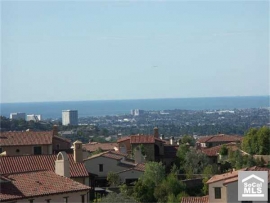

Irvine Home Address … 25 RIDGEVIEW Irvine, CA 92603
Resale Home Price …… $3,999,000

Little darling
It's been a long, cold, lonely winter
Little darling
It feels like years since it's been here
Here comes the sun
Here comes the sun, and I say
It's alright
The Beatles — Here Comes the Sun
Are we at the dawn of a new bull market in residential real estate? Is the bottom close at hand? The double dip recently became official, both nationally and in Irvine (see below), so perhaps it is premature to call the bottom just yet. The current trend is decidedly down. The price plot intersects the bottom right corner of the two-year chart reflecting the worst possible market condition.

It always looks very dark at the bottom, and after a little more weakness, we should see the seasonal pattern take over and the first of many seasonal rallies will mark the bottoming of prices in the $300/SF to $360SF range over the next three years, perhaps five. This next bottom may not be our last. If interest rates remain low while jobs and incomes recover, prices may bottom this spring. However, if interest rates begin a multi-year or multi-decade climb, higher financing costs will be a constant market headwind.
As for the Irvine housing market, in my Predictions for 2011, I stated the following:

Basically, my outlook for 2011 is unchanged from 2010. (1) Inventory will go up. (2) Properties selling at or below rental parity will be the norm. (3) Sales volumes will increase. (4) Prices in Irvine will fall 2% to 5% in 2011.
Whatever the result, the leg down in pricing from the double-dip will be the last move down in this market cycle. The housing market will bottom at different times in different market tiers. I think the biggest discounts will be at the high end going forward. The lowest tier of the housing market may have already hit bottom. If not, it will bottom first. With low end support producing the first wave of move-up equity buyers, the slow grinding declines of higher price points can finally cease, perhaps in 2014. During the next three years, expect a range-bound housing market with a slightly lower bias.
Why 2011 May Be the End of the Housing Crash
FEBRUARY 27, 2011 — By SIMON CONSTABLE
There might finally be some good news this year about the nation's dismal housing market. Or, at least, the bad news could stop.
We might have good news? The bad news could stop? There is a man who is hedging his predictions before he even makes them.
Either way, it will be welcome relief for current homeowners as well as for potential real-estate investors. Reasons to be optimistic have been sadly lacking since the housing bubble burst in 2006.
It may be a welcome relief to some, but higher house prices are not a relief to future buyers. I guess they don't count.
For sure, last week we learned the widely watched S&P/Case-Shiller home-price index fell 1% in December, its fifth straight decline. The index tracks 20 major markets.
But that figure belies real reasons to be optimistic, according to some experts. If they are right, it might make sense to jump into real estate. The trick is avoiding getting burned again, and it doesn't necessarily mean owning a home.
First, let's recap the economic signs a bottom is close.
Houses Are a Good Deal
Housing is the most affordable it has been in decades, according to analysts at Moody's Analytics. They don't just look at house prices. They also look at incomes.
Nationally, the cost of a house is the equivalent of about 19 months of total pay for an average family, the lowest level in 35 years. Prices usually average close to two years' pay, although that varies nationally.
When a market is at the bottom, despair is widespread. The homebuilders show this classic signal. They rate affordability an A+ while volumes and inventory earn Fs. Builder sentiment indicators are at historic lows. That is the dynamic at the market bottom. 
At the peak, midway through the last decade, a home in Los Angeles cost the equivalent of 4.5 years' pay. The average price has since fallen to just over two years' income now. That's well below its pre-bubble average of 2.6 years. This means average Los Angeles homes are cheaper in “real terms” than they were typically during the period 1989 through 2003.
The opposite is true around the Washington beltway, where it will take 26 months of pay to buy a home, versus the historical norm of 22 months.
The opposite is true here in Irvine as well, but affordability is improving as evidenced by the daily posts where nicer and nicer properties are starting to appear at rental parity.
In the end, it will be affordability that will drive people to buy homes.
“Pricing is down so much in some markets that when you analyze renting versus owning it makes much more sense to own,” says Michael Larson, a real-estate analyst at Weiss Research in Jupiter, Fla.
I have stated repeatedly for four years that a bottom is formed when it is cheaper to own than to rent. Once that condition is in place, then supply and demand issues predominate. For instance, affordability is not the problem in Las Vegas. Prices are 30% to 40% below their historic relationship between the cost of rental and the cost of ownership, yet there is little chance of appreciation until the overhang of supply is processed.

It is definitely bullish. But what about timing?
“Housing prices will probably bottom in 2011,” says Scott Simon, a managing director at money-management firm Pimco in Newport Beach, Calif. He foresaw the housing crash, helping his firm dodge losses that plagued Wall Street.
Mr. Simon says prices might dip another 5%. Still, in the scheme of things, that's small. Consider this: In some markets, home prices have fallen by half or more since 2006.
For instance, in once-hot Miami you can snap up an average house for under $166,000, according to recent data from the National Association of Realtors. That's down from $371,000 in 2006. Another 5% drop would take it to $158,000.
Many of the properties I look at each day in Las Vegas have already declined 70% from the peak. Another 5% is a rounding error compared to the decline that already occurred. If the property is being purchased at a significant discount to rental parity, any temporary declines in value can be partially offset by the monthly savings.

Properties locally will likely decline another 5%, but this too is not so significant as to be a major reason for worry. The slow decline followed by a tepid rally will leave most buyers over the next few years unable to sell without losing money — which is a good reason not to buy.
With no savings over renting, there is no compelling reason to buy; however, with the likelihood of another 30% decline being remote, unlike four years ago, there is no compelling reason to rent either.
Investors Stepping Up
Here's another sign the market is nearing a bottom: Investors have started to buy up houses and condos, in some instances paying entirely in cash. That's a far cry from the heady bubble days when borrowed money seemed the key to riches. The bubble-era speculators who got burned tended to buy at the peak and borrowed heavily to do so. When the crash came, they quickly saw their wealth erased.
Take Miami again. Last year, more than half of all transactions were made entirely in cash, according to a recent report in The Wall Street Journal. That compares with 13% of deals in the last quarter of 2006, the height of the bubble. Similarly, in Phoenix 42% of sales in 2010 went to all-cash buyers, up threefold since 2008.
Cash buyers are required to take up the slack in areas where the indigenous population cannot qualify for loans. Sales volumes remain so low partly because unemployment is high, but partly because so many in the buyer pool now have bad credit and are unable to buy.

It's a sign that these investors are betting on a rebound. Investors buying at current prices are looking for deals, or so-called bottom fishing. They typically like to pay entirely in cash (or with a relatively small loan) to speed up transactions. That can be vital for an investor wishing to lock in a deal fast.
If this is a turn in the market, then it might make sense to go out and buy a home. But, warns Pimco's Mr. Simon, “buy in areas you really know.”
Plan to Stay Put
Buy and hold. While the good news is that the worst of the housing crash might be over, the bad news is that the fast gains of the glory days of 2005 and 2006 won't be back any time soon. So to cover the costs of buying and selling, and what could be a prolonged recovery, plan to own for more than 10 years, explains Jack Ablin, chief investment officer at Chicago-based Harris Bank.
Over the next several years, we will see many bear rally buyers price their homes at 6% more than they paid and pray that a greater fool comes along. It will be a property profile you will tire of seeing.
The plethora of semi-discretionary sellers holding out for purchase price plus commissions will create the downward stickiness usually associated with real estate markets. It will create an environment of low sales rates for many years to come as buyers cannot afford to pay the prices sellers require to sell.
The level of debt distress will be less in this new housing market. Many will still maximize their debts to play the Ponzi scheme, but they will be doing so with stable amortizing mortgages, hopefully with fixed rates.
.jpg)
Sellers have a high discretionary price because they don't want to take a loss. Therefore, transaction volume depends on how much demand can be generated at preset price points. If many people go back to work and earn large wages, then transaction volumes will pick up as buyers can meet the high asking prices. However, if unemployment lingers and wage growth is tepid, real estate prices and transaction volumes will remain depressed, and the market will take years to clear out.
Perhaps they will come up with some innovative loan programs….
Also remember that borrowing money to buy a house can still be risky. If you pay for a $100,000 property with $20,000 cash and borrow the rest, a dip in the value of $20,000 would leave you with zero equity. On top of that, you'd have to pay to maintain and repair the property, something not necessary when renting.
The flip-side of that transaction is to wait and save 20% and buy when prices are cheaper. That's what I told everyone to do four years ago. Now, I don't think prices will drop far enough to worry about or to wait for. Although, I don't think they will roaring upward any time soon either.
Home Buying Without a House
There are other ways to benefit from a real-estate rebound than directly buying a house. Such investments include stocks, mutual funds or exchange-traded funds. Unlike homes, which typically cost tens of thousands of dollars, these financial investments can be made in smaller amounts and typically are easy to sell.
Weiss Research's Mr. Larson says although new homes are oversupplied, home builders might benefit from a rebound as the situation rights itself.
Rather than pick individual stocks, he says, it probably makes sense for small investors to pick broader investments that hold many different stocks. In particular, he points to the SPDR S&P Homebuilders ETF (XHB), which tracks a basket of home-builder stocks.
Mr. Larson also highlights specialized mutual funds such as the Fidelity Select Construction & Housing fund (FSHOX), which tracks home builders as well as home-improvement retailers like Home Depot and Lowes that would also likely benefit from a housing recovery.
With homebuilding activity at historic lows, buying ETFs that will benefit from increased residential investment is a good value play depending on your timeframe.
Now, how about that elusive market bottom….
Peak Ponzi, big loss
Today's featured property was originally purchased on 12/22/2006 for $3,953,500. The owner used a $2,912,449 Option ARM!
Now think about this: they aren't giving out $2,912,449 Option ARM loans anymore. The number of people who are willing and able to qualify to take on that kind of debt are few and far between. That's why the high end pricing must come down.
The owner also used a $250,000 HELOC and put down $791,051. That's a lot of money to walk away from.
Foreclosure Record
Recording Date: 06/05/2008
Document Type: Notice of Sale
Foreclosure Record
Recording Date: 02/27/2008
Document Type: Notice of Default
The bank took this property back on 1/22/2009 for $3,206,666 where it remained in shadow inventory — you know, that inventory everyone denies is there. Now it is for sale, and the bank honestly believes they will get peak pricing. Perhaps they will underwrite a new option ARM with a 1% teaser rate? It's the only way they will get their price.
Irvine Home Address … 25 RIDGEVIEW Irvine, CA 92603 
Resale Home Price … $3,999,000
Home Purchase Price … $3,206,000
Home Purchase Date …. 1/22/09
Net Gain (Loss) ………. $553,060
Percent Change ………. 17.3%
Annual Appreciation … 10.2%
Cost of Ownership
————————————————-
$3,999,000 ………. Asking Price
$799,800 ………. 20% Down Conventional
4.25% …………… Mortgage Interest Rate
$3,199,200 ………. 30-Year Mortgage
$758,803 ………. Income Requirement
$15,738 ………. Monthly Mortgage Payment
$3466 ………. Property Tax
$585 ………. Special Taxes and Levies (Mello Roos)
$667 ………. Homeowners Insurance
$495 ………. Homeowners Association Fees
============================================ 
$20,950 ………. Monthly Cash Outlays
-$1962 ………. Tax Savings (% of Interest and Property Tax)
-$4408 ………. Equity Hidden in Payment
$1222 ………. Lost Income to Down Payment (net of taxes)
$500 ………. Maintenance and Replacement Reserves
============================================
$16,303 ………. Monthly Cost of Ownership
Cash Acquisition Demands
——————————————————————————
$39,990 ………. Furnishing and Move In @1%
$39,990 ………. Closing Costs @1%
$31,992 ………… Interest Points @1% of Loan 
$799,800 ………. Down Payment
============================================
$911,772 ………. Total Cash Costs
$249,900 ………… Emergency Cash Reserves
============================================
$1,161,672 ………. Total Savings Needed
Property Details for 25 RIDGEVIEW Irvine, CA 92603
——————————————————————————
Beds: 5
Baths: 6
Sq. Ft.: 6055
$660/SF
Lot Size: 0.53 Acres
Property Type: Residential, Single Family
Style: Two Level, Mediterranean
View: Bay, City Lights, City, Coastline, Mountain, Ocean, Panoramic
Year Built: 2006
Community: Turtle Ridge
County: Orange
MLS#: S526948
Source: SoCalMLS
Status: Active
——————————————————————————
At the very top of Turte Ridge, this is the ONLY Plan 3 that's hit the market and worth the wait. Highly sought after, this property is the largest of the LACima plan homes, with over 6,055 of living space on a huge lot at over 23,000 square feet at the end of a very quiet cul-de-sac. Absolutely no view obstructions. You can see all the way from the ocean to the Saddleback mountains with no roofs! Upgrades throughout the interior including faux wall painting, additional fireplaces and highly upgraded bathrooms. Wait till you see the view from the master bedroom!! This home is priced to sell.
Why the repeat listing? This property was on the weekend post.
Where in LA is it 2x income? My parents live in WLA near SM and their neighborhood is at best 5x income.
“Why the repeat listing? This property was on the weekend post.”
Because I made a mistake. I have changed the post.
I don’t know how they are saying LA is affordable. Perhaps the under-median neighborhoods are affordable, but nothing nice is.
The nice areas of LA are affordable to those buying with tons of money and high incomes.
PR – you are funny. The word affordable has no meaning in your world.
yes there are people with tons of money and high incomes and there will always be someone who can afford any price point listed. my point is that there arent many LA neighborhoods where the median house price is 2x the median income. maybe the really bad neighborhoods but no where near the areas i grew up in.
my father is a university prof and when he bought in WLA in 94, the house was about 2x income. 16 years later, his income is much higher and he cant buy his own house without stretching. our house is about 4x his income today. i am sure there are others out there who can buy our house at 1x income but i doubt my neighborhood is suddenly attracting a higher income group of people
It’s a good thing your father doesn’t need to buy his house today. Like most of his neighbors they can continue living there until they die or choose to move. Prices are set based on available inventory and incomes and asset for those who demand living in prime LA neighborhoods.
so you think my parents neighborhood not attracts a higher wage earner relative to price or that the price of the houses will drop?
“Prices are set based on available inventory and incomes and asset for those who demand living in prime LA neighborhoods.”
Only half true. Prices are not set, but rather influenced by numberous factors,including the most important which you left out; the availability of credit, whether the lender can afford it or not.
Oops, I meant whether the “borrower” can afford it or not.
I’m saying that people are currently buying in your fathers neighborhood with normal debt to income ratios DTIs, and 20% down payments like the good old days.
Where’s the landscaping? Where’s the pool? 4 mil?
I guess the original owners ran out of money for a yard and then they get foreclosed on.
Yeah, I was thinking the very same thing.
At a minimum it will cost $500K to properly landscape the backyard.
No telling what the front looks like.
That $500K comes out of pocket and cannot be rolled into the loan.
This is a huge red flag for a buyer to incur after dropping $4M
Also, the words “Plan 3” juxtaposed to “4 million bucks” are bizarre. For that kind of money, I’d want C-U-S-T-O-M.
I guess this house will find a buyer for a cool million.
4 million for a tract house? LMFAO
I am sorry but the bottom is quite a long ways off. In the age of deleveraging people will simply not have the financial where-with-all to buy homes. Renting, that is leasing of homes, will be a privilege extending by banks to a select group of individuals.
In my article Seigniorage Fails Causing Banks To Fall Lower Commencing The Mother Of Market Of All Bear Markets … http://tinyurl.com/4akzrt8 … I wrote:
March 1, 2010 is a day that will live in financial infamy as it confirmed the that the seigniorage of the Milton Friedman Free To Choose Currency Regime, which was based upon Quantitative Easing and Quantitative Easing 2, failed on February 22, 2011, when the distressed securities taken in by the Federal Reserve under its TARP Facility traded lower, as is seen in the Fidelity mutual fund FAGIX trading lower.
This resulted in world stocks, ACWI, turning lower.
On March 1, 2011, seigniorage continued to fail, as is seen in FAGIX, continuing to fail, which induced the banks, KBE, to trade 2.1% lower and world stocks, ACWI, to trade 1.4% lower.
We live in a bank centric and also an oil centric world. The world’s leading banker Ben Bernanke, in a semiannual report to Congress, told politicians that commodity price inflation, and oil prices more specifically, could pose a threat to economic growth and price stability if sustained at high levels, while at the same time reassuring markets and politicians that inflation remained low and expectations stable according to Forbes Blog.
Leading the Banks lower were the institutions which rose in value the most during the last two years under Ben Bernanke’s expanding seigniorage. These included Fifth Third Bancorp, FITB, Huntington Bankshares, HBAN, Regional Financial, RF. Bank of America, BAC, Citigroup, C, Wells Fargo, WFC and Sun Trust Banks, STI.
The contraction of seigniorage, that is moneyness, is the root cause of the failure of stock markets worldwide, VT, -1.7%.
The contraction of seigniorage seen in the fall of the distressed securities mutual fund FAGIX means the beginning of the end of credit as it has traditionally been known.
The world did not witness debt deflation on March 1, 2011, as much as it witnessed inflation destruction, which Urban Dictionary defines as the fall in investment value that accompanies derisking and deleveraging out of investments that were formerly inflated by money flows to, and carry trade investing in, high interest paying financial institutions, profitable natural resource companies, and high growth companies. Companies falling massively to inflation destruction included.
Bruce Krasting reports “Senator Shelby asked Bernanke to explain how he came to the $600b QE2 program. The answer came at minute 32 of this C-SPAN clip. Ben explained that he felt that a monetary ease equivalent to a 75 BP reduction in the Fed Funds rate was in order to avoid deflation. He equated $150-200 billion of QE as being equivalent to a 25BP reduction in short term rates. The justification for QE all along has been that monetary policy is range bound by zero interest rates. QE brings us below “0” in equivalent policy.” The sum of QE 1, QE lite (the top off of QE1) and QE2 is $2.35 trillion. Using Bernanke’s formula you get a range of 4% to 5% as the approximate interest rate consequence of QE. (2.35/.15 or 2.35/.2) That is an extraordinary number. The Fed’ ZIRP policy set interest rates at zero. QE has brought that to -4.5% (average) based on Ben’s numbers.”
The world is passing has passed through an inflection point: the world has passed from the Age of Leverage and into the Age of Deleveraging with the exhaustion of Quantitative Easing and with the failure of yen carry trade investing, as seen in the failure of the Optimized Carry ETN, ICI, on the very day that QE 2 was announced.
The Age of Leverage was characterised by debt expansion, credit liquidity, stability, economic growth and expansion and prosperity … The Age of Deleveraging is characterised by inflation destruction, debt deflation, credit ill-liquidity, instability, economic contraction and austerity.
One impact of the failure of seigniorage and inflation destruction, will be that in the age of deleveraging people will simply not have the financial where-with-all to buy homes. Renting, that is leasing of homes, will be a privilege extending by banks to a select group of individuals.
“this is the ONLY Plan 3 that’s hit the market and worth the wait.”
the word “plan” should NEVER be used with a listing over a million dollars. only in irvine…
The same plan, by the same builder, on the same sized lot, with equivalent views is available in San Clemente for $1.4M.
Days on Market – 1068 and counting…
The manager who handles foreclosed properties for this bank should be shown door.
In reality they will get a bonus for delaying the loss the bank needs to take on its books for so long.
Walter: your post made my day.
I’m just imagining the bank clerk getting a plaque with “1000 Days” in big letters. Mission Accomplished. 🙂
I won’t be surprised if any/both of the above mentioned statements are true…
Seriously, how does bank’s loss mitigation department work? Do they not have to pay for association fees, property taxes, maintenance on the property etc? Should they not market the property better or lease it?
I
The way we valuate real estate is likely to change as it becomes further apparent that America’s #1 fiscal problem is not medicare, social security, or collective bargaining, but rather America’s never ending investment into propping up real estate.
I don’t like using the term, “it’s different this time”, but in reality it will be different “this time”. With that said, we really don’t know how valuations of real estate will look like in the next 10-20 years, but I think it’s safe to say valuation will reflect a new economic paradigm.
Ponzi economies only last so long, and it’s apparent that America’s economy will either bust, or be forced to reform into the 21st century, because the old tricks are having less impact.
Just my 2 cents.
It’s safe to say there is a new economic paradigm?
LOL, it’s far more likely to repeat itself 10 years from now, next time don’t forget to join the party.
I know there will be real estate cycles, but I doubt if we’ll see anything that resembles 2001 to 2006 in my/our lifetime.
The world is changing, and the value we place on real estate will also change.
Lee, thanks for your comment on IR’s article as I appreciate the words you use — a “new economic paradigm”. I’ve been looking for those words and will use them in the future.
The old economic paradigm supporting seigniorage, and ponzi economics, was the neoliberal Milton Friedman Free To Choose floating currency regime which has been based upon US Treasuries, and then lately QE 1 with its TARP Facility, in which money good US Treasuries were traded out for distressed securities like those held in Fidelity Mutual Fund FAGIX, with the banks placing the Treasuries in Excess Reserve, as well as QE 2 where Ben Bernanke used his authority to print money out of thin air and buy US Treasuries.
The old paradigm failed February 22, 2011, with the downturn in distressed securities, like those held in FAGIX, which caused the stock market to turn lower.
A new economic paradigm will emerge out of Götterdämmerung, an investment flameout, where a Chancellor, that is a Sovereign, and a Banker, a Seignior will arise to provide a new seigniorage, that is a new moneyness with austerity and democratic deficit for all.
“If interest rates remain low while jobs and incomes recover, prices may bottom this spring. However, if interest rates begin a multi-year or multi-decade climb, higher financing costs will be a constant market headwind.”
I agree with this completely, but I really think the jobs (and the related loss state and federal tax revenues) part of the equation should get first billing, especially in California with it’s high SFH home prices and ridiculous state budget situation, which in case anyone forgot, has not improved one iota.
When I look at what Wisconsin’s governor is trying to pull off in Madison and then I glance over at Sacramento, I have to laugh. We are so screwed in California, it’s not funny. I’m thinking to myself “Yeah right, when hell freezes over”.
In my view, those willing to shell out anything between $500K to $700K for a SFH will be so few and far between because high paying jobs ($100K-$150K) are either not easily found anymore , or because confidence in maintaining current high pay employment over the next 6 to 18 months has taken a serious hit. This drag on employment confidence is because even growing companies in successful, expanding, high-tech industries in OC and California are all taking inventory again of their cost basis and making major moves to do achieve more with fewer heads.
Combine this with the federal and state governments tightening their belts in the next fiscal year and 2012-13, fewer dollars for short and long term national projects will affect a lot of businesses nationally and in California over the next 12-36 months. I don’t think the impact of this is registering with John Q. Public, let alone those who demand to collect real estate commission checks.
Of course I could be wrong, but I just don’t see the all-important jobs variable improving in California any time soon.
Not that the NAR or California Realtors ever gave a damn about jobs in the first place. We all witnessed banks issuing ridiculous amounts of low cost mortgage financing to school bus drivers making only $30K per year. Are those days over? I hope so.
Most educated people who have a gainful employment right now are:
1.) Elated.
2.)Doing everything they can NOT to lose that job and their insurance.
3.) Finding a second job, if they possibly can.
4.) Implementing further austerity measures with their household budget
5.) Saving money up for an emergency fund (in case they do get shit-canned).
It’s hardly a surprise that buying a home has been put on the back burner for a lot of people under current economic circumstances.
2012-2013 bottom is looking more likely by the day.
I have been thinking about writing a post on the happenings in my home state of Wisconsin. I was shocked at the power this man is wielding against the unions, and he does not fear losing his next election nor will his supporters get creamed in the legislature.
The connection between the states fiscal health and the housing market is very real. The result of the Wisconsin governor’s efforts will be to hurt house prices as he cuts salaries and lays people off. He should still do it to end the union subsidies, but it will not be painless. It would be even more painful here.
I have been saying the same thing since 2005. the bottom in nominal dollars will be half way through 2012, and years past that in inflation adjusted dollars.
But, I will be happy to change my forecast if anything changes. So far, nothing has.
We can’t be close to the bottom.
Commenters here said that prices in Irvine would be 40%-50% lower… we’re only at about 25% (in some areas, we aren’t even 15% lower).
Heck… AZDave said 1999 unadjusted prices… that’s over 60% off.
Maybe in 2013?
I agree with the statement that the high end is not close to the bottom. Nothing has changed for the better since 1998.
For the sucessful top third of society plenty has changed since 1998. Your salary should have doubled at a minimum.
If it hasn’t you have only yourself to blame. Sorry for the dose of reality. Nothing has changed for you since 1998? Damn that sucks.
Except now they rely on two incomes to do it.
A bottom? I can’t hardly see how.
If the bottom you’re describing is based upon continued low or lower interest rates and an improving job market then I fail to see how any excitement for that idea can be generated. Job reports are uninspiring; any improvement is simply because people are falling off the jobless rolls. Interest rates were even lower just a few short months ago and all that happened was that a temporary prop was put under the market; there certainly wasn’t any improvement.
And I fail to see how the rent vs own indicator is a valid indicator whatsoever. My rents have been falling since I moved to my present location in 2007. They stopped falling this year but what’s to say they don’t go lower in the future.
You see the thing is that none of the problems have been solved. Even though home prices have come down the only way prices head up again is if the debt bubble gets blown again. And has the debt bubble from the 2000’s been solved? No way, it’s just been shifted to the taxpayer for the most part or hidden in Level 3 accounting. So where is this additional debt coming from? And what happens when the cash buyers begin to realize that prices aren’t going up.
The way I see it is that we’re simply treading water with just the tip of our nose remaining above. The risk is to the downside and there will be no bottom until that changes.
Prices don’t need to go up for things to stabilize, they just need to stop falling – at the point they’re no longer falling, you’re at the bottom. There were 25 million more Americans in 2010 than there were in 2000. You can expect comparable growth from 2010-2020. That natural rate of household formation, plus the fact that many 20-somethings have delayed forming households, and that construction will be at effectively zero for a while, eventually demand will catch up to supply…in most areas. Some areas already have healthy demand, while others will not see a healthy balance even in 2020, and possibly not in 2030.
One thing IR will echo is that foreclosures are the way we get debt destruction. They are painful for the families involved, but they are a necessary pain. I find the idea that none of the problem has been solved to be absurd. We’ve probably worked through half the foreclosures that we need to.
Let’s say the seeds of the crisis were sown in 2004, and the crisis bottomed in 2010 and it takes an equal amount of time to get to a stable point as it took to bottom. That means 5 more years of treading water before things are where you can really feel good about them (no matter what anyone says, national unemployment > 9% is not good). That is a hard 5 years, but it’s a lot different than the stock up on food, gold & ammo predictions some have been making.
@ Winstongator – I can’t tell if you’re agreeing or disagreeing with me.
My point was that the best we could hope for right now was to tread water with all the risk still to the downside. Other than your statement that “We’ve probably worked through half the foreclosures that we need to” (which I don’t see as valid with all the upper end squatting going on) to be the only thing you mention that might support a case of a real bottom approaching.
As for the seeds of the crisis being sown in 2004 I think you’re completely underestimating the problem. I can make a case for the ’80’s or even when the Federal Reserve was established (1913?) as when the seeds were sown but that seem irrelevant to me. Societies move in predictable waves, always have and always will, and my feeling is that the correction needed here will not last just a few short years to make up for decades of excesses.
The boom and bust cycles will continue forever. This is not the last bust. Inflation will eventually kick in, it will devastate some (the lower third), and have little effect on some as their assets and income will increase with inflation… For the top third their asset and income will increase at a greater rate than inflation. Welcome to America. This bust is not different just more of the same.
I don’t think I would make the assumption that all corrections are the same. Tell that to people who lived through the Depression and they’ll laugh in your face.
And look where we are today
I’m disagreeing. Most of the distressed properties in SoFla, the area I’m familiar with, that have seen > 50% declines in prices relative to their outstanding loan balance will have gotten foreclosed by the end of 2011. If there’s no mortgage, home prices falling hurt, but hurt a lot less. If the owner can bring cash, they’ll refi. Strategic defaulters are mostly already gone. So there will be a backlog of REO and the existing inventory, but new REO coming into the system will slow.
The easiest way to understand what I’m trying to say is that, in nearly every market (I won’t speak for Detroit), the odds on your buying a home now and not being able to sell it for 1/2 what you paid in 2-5 years is negligible. There may be another 10% reduction in prices, but that can be absorbed. We will probably see another large bank failure, but that will be much better absorbed than in the Summer of 2008.
The American way of life, as I know it (not the HELOC money > income CA way of life) is most threatened by unemployment. While it will be slow, the employment situation will continue to get better.
“the odds on your buying a home now and not being able to sell it for 1/2 what you paid in 2-5 years is negligible.”
Maybe I’m being dense but I don’t understand this. Are you saying that we won’t experience another 50% drop in 2-5 years and because of that it means the bottom is in?
“There may be another 10% reduction in prices, but that can be absorbed”
I wouldn’t be so quick to underestimate what another 10% drop would do.
“While it will be slow, the employment situation will continue to get better.”
There’s been improvement in employment? Not from my vantage point. I see a lot of BLS bs with birth-death models and long term unemployed dropping off the unemployment rolls but I see very little in the way of improvement that cannot be considered anything more than noise.
To speak plainly ,I don’t view a bottom as grinding along at a low level for a continued period of time without anything getting better. Just because things aren’t getting worse doesn’t mean their getting better.
I would love to be excited about a real change in direction happening but with the fraud just being covered up and no real changes have occurred and “extend and pretend” being the rule of the land and guaranteed to failure colossally at some point then I’m just not excited about our prospects.
“To speak plainly ,I don’t view a bottom as grinding along at a low level for a continued period of time without anything getting better. Just because things aren’t getting worse doesn’t mean their getting better.”
You doofus, that is EXACTLY what a bottom is – the thing you are measuring is NEITHER going up, NOR going down.
What you are hoping to see is called “recovery”, that is to say the chance of the thing you are measuring actually rising. You are right to say, ” I dont see much chance of a recovery” – very defendable based on what you are seeing and saying. Nevertheless, what you described, as I highighlighted above is the EXACT definition of a “bottom”
I don’t see Irvine or other CA costal regions selling for 2X income. More like it 3 to 4X income. In the 1980’s a simple condo in the PR of SM was selling for 3X-4X income. That condo is 5X income now.
NAR, govt are saying the affordability is going down based on the interest cost of borrowership and a relatively short time span.
PR, the top 3%-tile may of doubled their income but the vast majority have only risen less than 5% per year. For the last 3 years wages have gone down for most folks, especially for those not working.
O.C.’s priciest mansion faces foreclosure
http://lansner.ocregister.com/2011/03/02/o-c-s-priciest-mansion-faces-foreclosure/101563/
There are some positive and negative signs as far as whether 2011 is the bottom.
On the positive, I recently read an article which pointed out that many buyers are finally realizing that if they suck it up and sell their current house at a loss, they can still move up to their dream house, since that too is selling at a deflated price. I’m sort of in the current situation myself – my house is worth less than what I bought it for ten years ago, but along the way I avoided HELOC temptation and actually refinanced at 15 years about 3 years in. As a result I still might be able to pull enough equity out in a sale to make a down payment on a larger home.
On the negative, if the spike in gas prices continues, it will certainly throw a wet blanket over everyone’s parade. Houses in the exurbs will be hit hardest. I think it’s no coincidence that the ’08 housing crash was preceded by a large spike in gas prices.
The exurbs are doomed. This gas price spike is not just a blip, but a move to higher prices. Those dollars China holds will let them buy oil. China has a 11-9 ratio of women to men. Think of those unmarried men. Is there any way to keep them from spending all their excess money on a car to impress women? World oil demand could easily double (China & India are 4x the size of Europe & US combined), but supply has no chance of doubling.